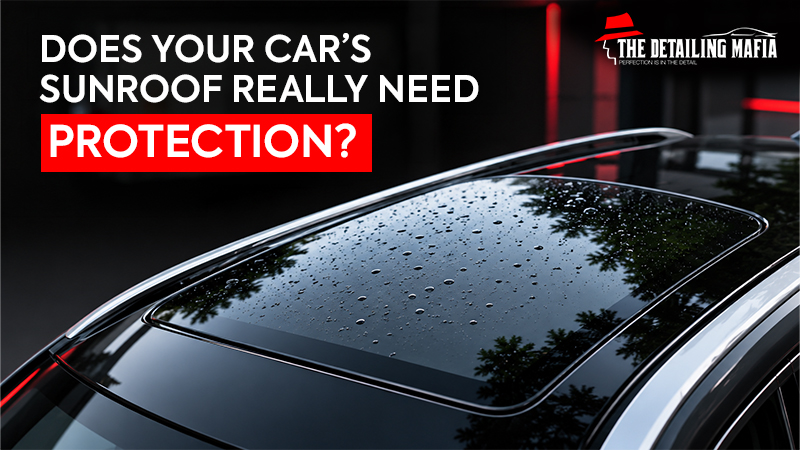
Does Your Car’s Sunroof Really Need Sunroof Protection Film?
Sunroof protection film is important in India because OEM sunroofs in cars are only partially protected from UV and heat. Car sunroof protection is a rising trend among Indian car owners due to the growing panoramic sunroof market.
Some roofs, like Range Rover’s, are laminated glass that won’t shatter, with a tint and a sunblind. Meanwhile, some cars come with panoramic roofs that ship with no sunshade at all. A sunroof protection film not only protects the glass but also protects passengers from UV and heat.
So if you are wondering whether your car’s sunroof really needs protection, read our expert-curated guide. We discuss sunroof UV protection and heat reduction, how to protect car interior fading from sun and whether you need sunroof protection film or not.
Do Indian Cars’ Sunroofs Need Protection?
With nearly a decade of experience in car detailing, we can surely say that Indian cars’ sunroofs highly benefit from added protection. Original equipment manufacturers (OEMs) build sunroofs with heavy factory tints and UV-blocking technology. But given the brutal summers and UV radiation, the glass is constantly put to the test. Why your car’s sunroof still needs to be protected by aftermarket sun film for sunroof:
- prolonged summer heat exceeds 45°C
- intense infrared radiation
- high humidity
- Unpredictable monsoon
What You Already Get In Your Car From Automotive Manufacturers?
Premium car brands in India are designing sunroofs with advanced technologies to make it compatible with challenging environmental conditions:
- advanced UV-blocking solar interlayers
- acoustic laminated safety glass
- heavy thermal sunshades
Car Brands with Factory-Treated Sunroofs
Rising temperatures not only affect and pressurize the glass but also affect interiors, causing cabin heat, premature graying, and fading of interior components. That’s why we see thermal resistance in factory sunroofs:
|
|
|
|
|
|
|
|
|
|
|
|
|
|
|
|
|
|
|
|
|
|
|
|
Sunroof Protection Film for Cars: What’s The Caveat For Car Owners
Factory-treated glass gives you baseline safety from heat and other damage so for real guarding, add aftermarket structural protection to survive the desert climate and protect the interiors. No OEM glass comes with ceramic coating, hydrophobic surface, or PPF. That’s why owners rely on non-OEM protection.
What Is Sunroof Protection Film?
Sunroof film for car is a protective thermoplastic polyurethane sheet applied over your car’s sunroof glass to protect it from thermal cycles, acidic contaminants and reduce the heat entering the cabin. With its self-healing ability, it also acts as a sunroof protector from hail. These films are highly durable in the Indian environment and offer:
- car sunroof protection
- sunroof UV protection
- sunroof heat reduction
- car interior fading from sun
What Are the Layers in Sunroof Protection Film for Cars
A standard sunroof film layers depend on its raw material. If it’s a TPH or PVC sun film, it’s generally a single layer. But premium brands like The Detailing Mafia use UltrashiledX sun films for sunroofs with high-performance 6-layer structure. Each layer has a dedicated function:
1. Hard coating:
This is the top layer
Resists scratches and UV
Dust, sand and cleaning marks don’t dull the surface.
2. TPU substrate layer:
It absorbs impact and stays flexible.
When a loose stone or debris hits the roof, this layer takes the hit.
Underneath stays safe
3. Functional layer:
The heat-fighter.
It rejects heat and blocks IR and UV before they reach the cabin.
4. TPU substrate:
A second TPU layer
Supports the functional layer
Keeps the whole film stable on curved glass
5. Acrylic pressure-sensitive adhesive:
It bonds the film to the glass.
No heat or chemicals are needed to make it stick
Holds under daily temperature swings
6. Release liner:
The backing sheet
Protects the adhesive until installation
The installer peels it off
How Does Sunroof Protection Film Prevent Cracks and Chips?
The hard coating and the TPU substrate of the sunroof film prevent cracks and chips by taking the first contact. Grit, sand and small debris hit it before they touch the glass, so surface scratches never get a start. The TPU layer works when stone strikes the roof; it absorbs the energy and spreads it instead of sending it into one point on the glass.
Less concentrated force means – fewer chips means — fewer cracks.
What Are the Benefits of Sunroof Protection Film?
Primary benefit of sunroof protective films is it reduces the amount of heat that enters the cabin through the glass. Glass protection, reduced pressure on AC, and protected heat are added perks. Let’s look at the benefits of UltrashieldX sunroof PPF:
|
|
|
|
|
|
|
|
|
|
|
|
|
|
|
|
|
|
|
|
|
|
|
|
|
|
|
|
|
|
|
|
How Much Heat Does Sunroof Protection Film Block?
A sunroof film with 40% VLT, 99% UV rejection, and 94% IR rejection could have an estimated TSER of around 50-65%. Exact total heat rejection depends on glass type, film’s VLT, and the film's spectral performance.
Where the heat comes from
|
|
|
|
|
|
|
|
|
|
|
|
|
|
|
|
Straight From the Expert:
Alok, Process Trainer at The Detailing Mafia with nearly 15 years of experience, explains the 95% heat block gimmick. He says we get customers who come to us to compare the heat rejection of the film with competitors’ IR-blocking numbers. We explain that 96% IR block does not mean 96% heat is blocked. IR forms only half of the heat; the other half is determined by UV and VLT. That’s why you should always look at the TSER (Total Solar Energy Rejection) rather than IR alone.
Why Your Car Needs UltrashiledX Sunroof Protection Film
The Detailing Mafia is one of the largest chains of car detailing studios with 260 outlets in nearly every big Indian city. It is backed by 39+ years of experience from the Manmachine Group and a decade of experience in the Indian car detailing market. The brand has a proprietary PPF brand – UltrashiledX that has the widest range of paint protection film, window films and sunroof protection films. Every installer at the studio is trained through a 3-level certification programme for the best finish. We have two options for your sunroof:
UltrashieldX Black Series Sunroof Protection Film
What black series sunroof protective films offer:
|
|
|
|
|
|
|
|
|
|
|
|
|
|
|
|
|
|
Technical Specs of Black series
|
|
|
|
|
|
|
|
|
|
|
|
|
|
|
|
|
|
|
|
|
|
|
|
|
|
|
|
|
|
UltrashieldX Sunroof Protection Film (SPF)
Why choose our protective film for sunroof:
|
|
|
|
|
|
|
|
|
|
|
|
|
|
|
|
|
|
Technical Specs of SPF Series
|
|
|
|
|
|
|
|
|
|
|
|
|
|
|
|
|
|
|
|
|
|
|
|
|
|
|
Our Verdict
Car sunroof protection is essential for car owners in India. Heat reduction, UV blocking and glass protection make aftermarket sunroof protective films the right choice. Factory glass handles only part of heat. A quality sunroof film fills the gap, cutting infrared heat, blocking UV, resisting chips and scratches, and keeping your cabin cooler. The Detailing Mafia offers two films built for these conditions. Protect your sunroof now, before the summer sun does the damage.
Frequently Asked Questions
Are car sunroofs UV protected?
Many car manufacturers in India treat the sunroof for UV protection. However, its not applicable to all cars. That’s why you should consider a sunroof protective film from aftermarket brands for maximum UV protection.
What are the main types of sunroof protection film?
Ceramic films and TPU films (sunroof PPF) are the main types of sunroof protection film. Ceramic films use nano technology for heat insulation but they lack a physical protection layer that can resist scratches and chips. Sunroof PPF is shock-absorbent and features a hard coat for UV nad IT blocking. Which means, with TPU sunroof film, you get both: heat reduction and impact absorption.
Which sunroof film works best for a panoramic roof?
An exterior-applied TPU sunroof film with high infrared rejection and high VLT is considered best for car panoramic roof protection. Panoramic roofs are big, so they gather the most heat, and they’re costly to replace. You can choose TDM’s UltrashieldX TPU Black Series Sunroof Protection Film with IR rejection of 94% and two VLT options.
Are expensive sunroof films worth the extra cost?
Cost alone does not decide whether a sunroof film is worth it or not.You need to look at other technical specs like UV, IR nad TSER rejection. Some premium studios might give you higher quotes if some surface preparation is needed before application. Investing in premium and advanced sunroof films is worth it.
How durable are sunroof protection films?
Sunroof protection film durability is around 8 years for TPU-based self-healing protective films. It depends on your maintenance, the film’s warranty and quality of installation.
Should I prioritize heat rejection or impact protection in sun film?
Both. But mostly, you don’t have to choose between them because TPU based sunroof sun film offer both. The functional layer rejects heat and UV, while the TPU layers absorb impact. That’s why choose a TPU protection film for sunroof with strong UV and IR rejecting numbers.
Want this for your car?
To get one done on your car or to know more, connect with us today.
Visit: https://www.thedetailingmafia.com/
Call: +91-80-100-44000 OR +91-92-894-44440